
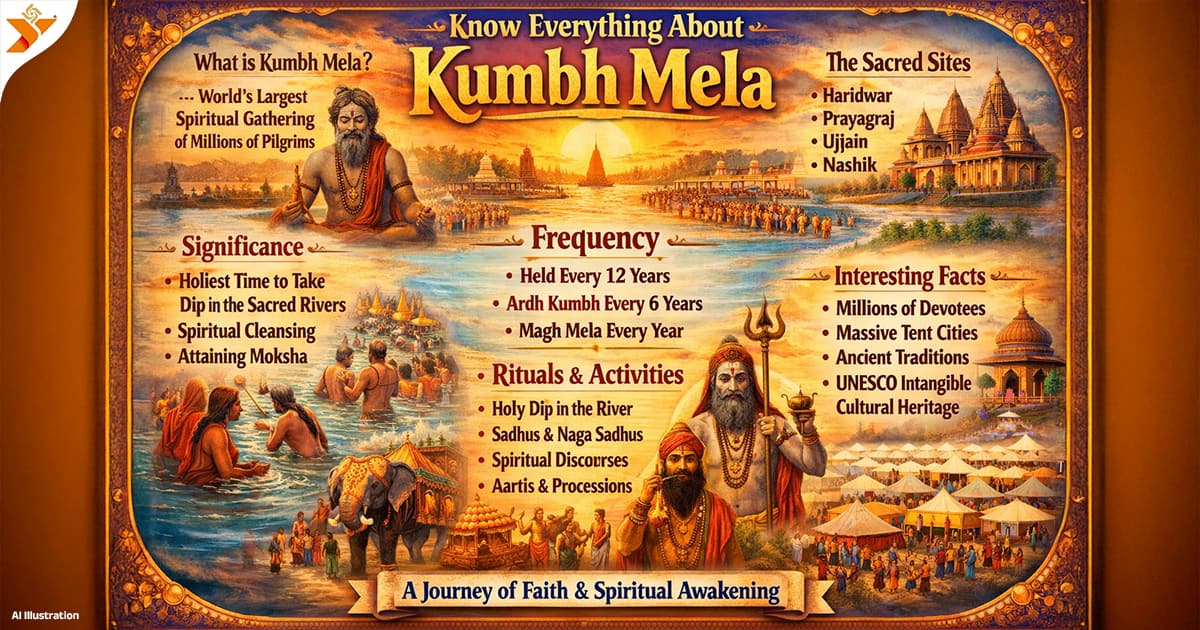
Simhastha Kumbh Mela, Nashik-Trimbakeshwar, is one of the most spiritually significant and centrally located gatherings. This event, which is held every twelve years in the divine regions of Nashik, Haridwar, Prayagraj and Ujjain, is drawing millions of devotees.
What is the Kumbh Mela?
The Kumbh Mela is the largest human spiritual gathering in the world. The divine Kumbh will take place at the four places, such as Haridwar, Ujjain, Prayagraj and Nashik. At astronomical alignment, when Jupiter enters Simha Rashi, then Nashik Kumbh happen, the guru enters Kumbh Rashi, then Prayagraj Kumbh happen, Surya enters Mesh Rashi, then Haridwar Kumbh happen and Surya enters Mesh Rashi at the same time the guru enters Sinha Rashi, then Ujjain Kumbh happens.
In the year 2026, Guru (Jupiter) enters Sinha Rashi, so the Kumbh Mela will take place in Nashik-Trimbakeshwar.


Spiritual & Scripture Significance of the Kumbh Mela
- Samundra Manthan: During the battle of gods and demons, Lord Vishnu drops the Amrit to the four places, such as the Godavari River (Trimbak-Nashik), Sangam (Prayagraj), Shipra River (Ujjain) and Ganga River (Haridwar).
- Godavari River: The Godavari River is believed to be the Ganga of the South, serving purification and liberation.
- Trimbakeshwar Jyotirlingas: It holds one of the twelve jyotirlingas of Lord Shiva, such as Trimbakeshwar Jyotirlinga. Which is also as sacred a place as Nashik.
- Ramayan connection: Panchvati Ghat, located at Nashik, holds the significance of Lord Rama during their 14 years of Vanavas.
Historical Evolution
Simhastha Kumbh Mela has developed over centuries as one of India’s most sacred and spiritually significant gatherings. Rooted in ancient scriptures and mythological beliefs. Then Simhastha Kumbh Mela happens in both places: Nashik and Trimbakeshwar.
Ancient Roots:
Simhastha Kumbh Mela is mentioned in multiple Puranas, such as Skanda, Brahma and Bhagavat, as a divine, reappearing festival tied to planetary movements.
Medieval & Maratha Influence:
During the ancient period of the Maratha, Nashik was promoted, with ghats, various temples and devotee routes.
Modern Management:
In the present era, the Simhastha Kumbh Mela Nashik is being managed and operated by the alliance between the government authorities, Akhada parishad and some civil agencies that trust you for the safety, transport, digital services and etc.
Rituals & Major Events
In each Kumbh, lots of rituals and events will be held.
Shahi Snan (Amrit Snan):
The main attraction of the Kumbh Mela is Shahi Snan, which is led by the various Akhadas on several tithis. All the Sadhus and pilgrims are dipping in the sacred river with chanting to wash away all their sins and feel blessed.
Parva Snan:
Parva Snan is also important as Shahi Snan because it also holds significant importance, like the Shahi Snan. On the different auspicious days or on tithi, lots of pilgrims come together at the ghat and take the Snan.
Yagna, Aartis & Satsangs:
During this holy period of the Kumbh Mela, devotees, sadhu-saints and spiritual people chant the dhuns, doing aarti, pujas and satsangs to feel spiritual. All these things will continuously happen during the whole Kumbh time.
Akhada Procession & Visiting
At the time of Shahi Snan in the Kumbh Mela, Akhadas are processing their place to ghats, to dip in the sacred river. People are observing their chants and spiritual teachings from saints. Every pilgrim can feel overwhelmed during this time.
Akhadas Tradition & Entry Order
In the Kumbh Mela, Akhadas are playing important role and each Akhada holds its own ritual. In the Shahi Snan, there is a sequence in which the Akhada dip in the river first and follow with every Akhada.
You can check the list below, which we have provided.
- Juna Akhada
- Avahan Akhada
- Agni Akhada
- Niranjani Akhada
- Anand Akhada
- Atal Akhada
- Mahanirvani Akhada
- Nirvani Akhada
- Digambar Ani Akhada
- Nirmohi Akhada
- Nirmal Akhada
- Bada Udasin Akhada
- Naya Udasin Akhada
When Will Nashik Kumbh Mela 2026 Start?
The Nashik Kumbh Mela depends on the Vedic and astronomical basis when the Guru (Jupiter) enters Simha Rashi. This Simhastha Kumbh Mela will start with dhwajarohan on the date of 31-October-2026 (the final date depends on Panchang and solar-lunar positions).
Where is the Simhastha Kumbh Mela Held?
Simhastha Kumbh Mela is held at both Nashik and Trimbakeshwar because of the sacred Godavari River.
At Nashik:
- Kumbh will happen in the ghats such as Ramkund, Godavari Ghat
- At these major Snan points, pilgrims come and take the holy dip
Trimbakeshwar:
- Kushavarta Kund
- Trimbakeshwar Jyotirlinga
In the city of Trimbakeshwar, which is the origin of the Godavari River. Lots of pilgrims come and take a visit to Trimbakeshwar Jyotirlinga (one of the twelve Jyotirlingas of Lord Shiva) to seek the blessings. Spiritually, both places, Nashik and Trimbakeshwar, are of significant importance.
How to Reach Nashik & Trimbakeshwar?
Nashik and Trimbakeshwar, both cities, are well connected by air, Railway and Roads. Pilgrims can easily catch the nearby relevant stations to reach Nashik.
By Railway:

- Major Railway Station: Nashik Road Railway Station
- The city of Nashik is smoothly connected to the major cities like Mumbai, Pune, Hyderabad, Ahmedabad, Chennai and Kolkata. For the Kumbh Mela, special trains will start for every pilgrim.
- To reach Ramkund & Panchavati (Kumbh Mela places), lots of auto-rickshaws, local buses, taxis and other vehicles are available.
- If the pilgrims want to travel to Trimbakeshwar, then from the Nashik Road Railway Station, vehicles are available to reach Trimbakeshwar, which is around 38 km away.
By Road:

Nashik city is widely connected to the national highways and the state highways.
The major routes include:
- Ahmedabad-Nashik: NH 48 & NH 160
- Pune-Nashik: NH-60
- Mumbai-Nashik: NH-160 Highway
Also, to avoid traffic congestion, Maharashtra State Transport (MSRTC) and private buses operate travel services to Nashik from major cities.
By Air:

Airport: Nashik (Ozar) Airport
- The Ozar Nashik Airport is around 24 km from the Nashik city centre.
- There are some direct flights available to Nashik from the major cities and this number increases during the peak Kumbh Mela days.
- If the pilgrim flow is high at Nashik Airport, then you should also consider the nearby Chhatrapati Shivaji Maharaj International Airport (Mumbai).
- The distance from Mumbai to Nashik is around 170-180 km, so you can reach it by any of the buses, trains, or taxis.
How to Reach Trimbakeshwar?
Trimbakeshwar is about 30 km from Nashik. Every day, pilgrims can travel to Nashik from Trimbakeshwar easily and the travel time is approximately 1-1.5 hours.
- Consistent MSRTC buses and special Kumbh shuttle services are utilised from Nashik CBS (Central Bus Stand) and Panchvati for the Trimbakeshwar.
- Private taxis, shared vehicles and other vehicles are widely available for transportation.
- Must follow the administration’s advice on the official routes during the Kumbh Mela when the traffic is out of control.
Accommodation & Stay Options
Various accommodations are available to stay comfortably with your family.
Tent Cities:
- Various 4-tent cities will be established
- Tent cities will be in different zones for Tirthyatris
- Basic to premium tents
Hotels & Lodges
There are lots of budget hotels, mid-range hotels, and premium hotels available with all modern amenities, offering comfortable stays near the Kumbh Mela locations.
Dharamshalas & Ashrams
Dharamshala and Ashrams are very affordable to stay at, and there are lots of accommodations available for your family in Nashik and Trimbakeshwar.
On-Ground Amenities
If you’re planning to visit the Kumbh Mela with your family and thinking of what types of on-ground amenities are provided, then provided below is the list of them.
- Drinking water stations
- Public Toilets & Urinals
- Medical & Emergency Camps
- Police & Security Help Centres
- Lost & Found Centres
- Food Distribution
- Paid Food Stalls & Shops
- Public Transport Shuttles
- Parking Zones
- Cloakrooms/Baggage Storage
- Bathing Changing Rooms
- Information Kiosks & Digital Screens
- Sandbag Pathways/Metal Walkways
- Tent Cities/Camps
- Wheelchair & Disabled Assistance
- Wi-Fi Zones (Selected areas)
- Charging/Mobile Charging Points
What Things to Carry
- Govt. Valid ID & Necessary documents
- Footwear & lightweight clothes
- Towel and Snan items
- Medicine and first aid
- Reusable water bottle & dry snacks
- Power bank
- Cash on hand, Credit cards
First-time Visitor Tips
A first-time visitor guide helps pilgrims ensure a comfortable and well-planned stay by highlighting essential tips, important preparations and key things to keep in mind for a smooth and spiritually fulfilling experience.
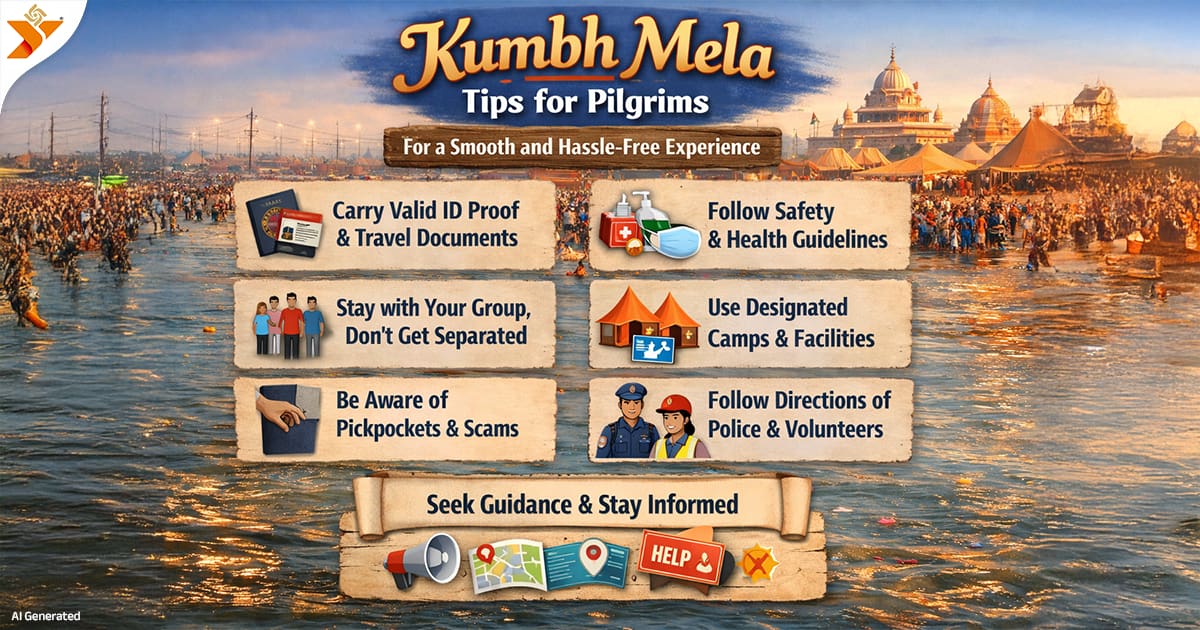
- Reach the Kumbh Mela early, especially during Shahi Snan
- Follow all the Akhadas rituals and traditions
- Listen to the instructions of the official administrations only
- Don’t book the stay without any confirmation or any fake links
- Keep all the necessary emergency contact information with you
- Always follow the protocols of administration
Participating in the Kumbh Mela is a lifetime experience that makes you feel spiritually connected. Dipping in the Godavari River during the Shahi Snan is considered the holiest and washes away all sins. All these details must be followed if you are visiting Kumbh for the very first time.
FAQ’s
The Kumbh Mela is the largest human spiritual gathering in the world. The divine Kumbh will take place at the four places, such as Haridwar, Ujjain, Prayagraj and Nashik.
The next Kumbh Mela will start on 31 October 2026.
In Nashik-Trimbakeshwar, the next Kumbh Mela 2026 will happen.
Various tent cities, dharamshalas, hotels, lodges, guest houses and ashrams are available to stay near the Kumbh location.
One government-issued valid ID card is a must to carry during the journey to the Kumbh Mela.