

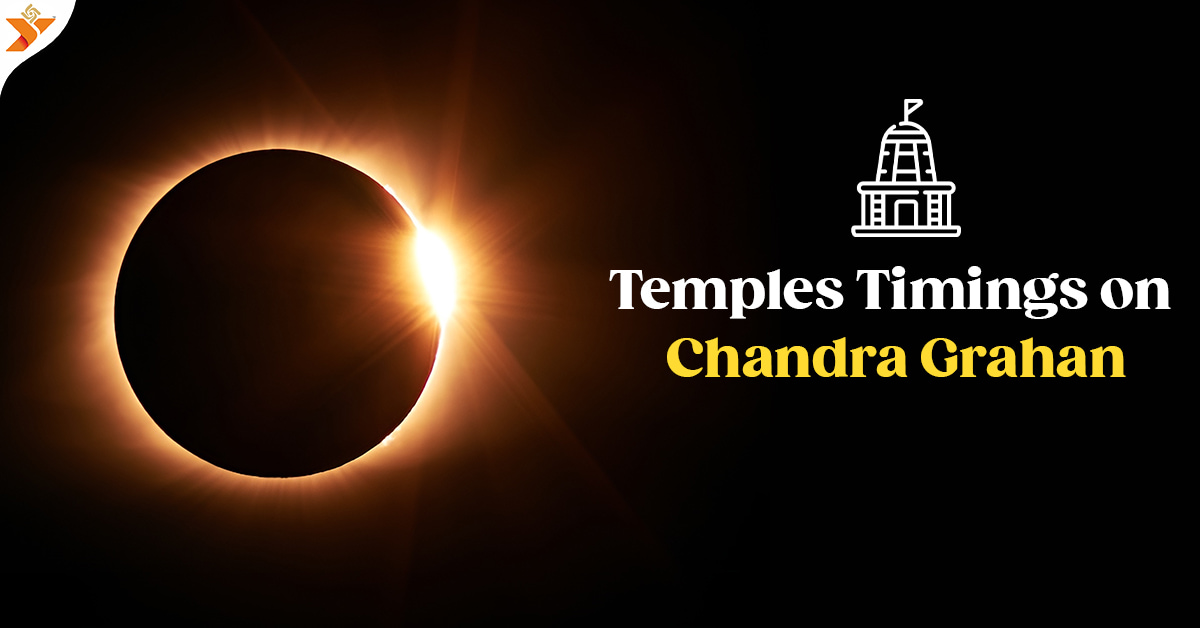
On Tuesday, 3rd March 2026, a total lunar eclipse (Chandra Grahan) will take place. This happens when the Earth comes exactly between the Sun and the Moon, blocking the Sun’s light from reaching the Moon. During the eclipse, the Moon will look deep red or crimson, which is often called a “Blood Moon.” This red glow appears because Earth’s atmosphere bends the sunlight and only the red shades fall on the moon.
In India, lunar eclipses are considered very important for religious reasons. Many temples follow special rituals and therefore remain closed during Chandra Grahan. Here you will get the temple timings on 3rd March 2026, Chandra Grahan.

Download YatraDham.Org Android App for more guides and easy booking.
What is Chandra Grahan?
A lunar eclipse (Chandra Grahan) is a celestial event that occurs when the Earth comes between the Sun and the Moon. That causes the moon to pass through the Earth’s shadow. This happens when the moon is in its full moon phase. During Chandra Grahan, the moon’s colour becomes a reddish or coppery hue, also known as “blood moon.”
Chandra Grahan 2026 – Timings & Visibility
The lunar eclipse on 3rd March 2026 will be visible in many parts of the world, including India. People can see the eclipse in the night sky when the Moon turns a reddish colour.
| Sutak Begins | 9:39 AM |
| Sutak Ends | 06:46 PM |
| Lunar Eclipse Begins | 06:26 PM |
| Lunar Eclipse Ends | 06:46 PM |
| Lunar Esclipse Duration | 20 Minutes 01 Second |
| First Contact with Penumbra | 02:16 PM |
| Last Contact with Penumbra | 07:52 PM |
| Duration of Penumbral Eclipse | 05 Hours 35 Minutes 45 Seconds |
| First Contact with Umbra | 03:21 PM |
| Last Contact with Umbra | 06:46 PM |
| Duration of Partial Eclipse (Umbra) | 03 Hours 25 Minutes 17 Seconds |
| Total Eclipse (Khagraas) Begins | 04:35 PM |
| Total Eclipse (Khagraas) Ends | 05:33 PM |
| Duration of Total Eclipse (Khagraas) | 57 Minutes 27 Seconds |
Temple Closure & Darshan Timings During Chandra Grahan
| Temples | Temples Closing Time | Temple Opening Time |
|---|---|---|
| Tirumala Temple | 09:39 AM (03/03/2026) | 07:52 PM (03/03/2026) |
| Kanaka Durga Temple (Vijayawada) | 09:39 AM (03/03/2026) | 03:00 AM (04/03/2026) |
| Mallikarjuna Jyotirlinga Temple | 06:00 AM (03/03/2026) | 07:30 PM (03/03/2026) |
| Somnath Jyotirlinga Temple | 9:39 AM (03/03/2026) | 07:30 PM (03/03/2026) |
| Mahakaleshwar Jyotirlinga Temple | Waiting for Time | Waiting for Time |
| Omkareshwar Jyotirlinga Temple | Waiting for Time | Waiting for Time |
| Rameshwaram Jyotirlinga Temple | 9:39 AM (03/03/2026) | 07:30 PM (03/03/2026) |
| Bhimashankar Jyotirlinga Temple | Waiting for Time | Waiting for Time |
| Kashi Vishwanath Temple | 04:30 PM (03/03/2026) | 07:15 PM (03/03/2026 |
| Trimbakeshwar Jyotirlinga Temple | 9:39 AM (03/03/2026) | Waiting for Time |
| Grishneshwar Jyotirlinga Temple | 9:39 AM (03/03/2026) | 07:30 PM (03/03/2026) |
| Venkanna temple | 9:30 AM (03/03/2026) | 07:30 PM (03/03/2026) |
| Kedarnath Temple | 04:35 PM (03/03/2026) | 05:33 PM (03/03/2026) |
| Dwarka Nageshwar Mahadev Temple | 12:00 PM (03/03/2026) | 6:47 PM (03/03/2026) |
| Dwarkadish Temple | 12:00 PM (03/03/2026) | 08:00 PM (03/03/2026) |
| Grishneshwar Jyotirlinga Temple | 03:00 PM (03/03/2026) | 07:00 PM (03/03/2026) |
| Jagannath Puri Temple | Waiting for Time | Waiting for Time |
| Salasar Balaji Temple | 06:25 AM (03/03/2026) | 07:00 PM (03/03/2026) |
| Shree Padmanabhaswamy Temple | 12:00 PM (03/03/2026) | Reopen with Nirmalya Darshanam (04/03/2026) |
| Kamakhya Temple | Waiting for Time | Waiting for Time |
| Laxminarayan Mandir, Delhi | 3:20 PM (03/03/2026) | 6:47 PM (03/03/2026) |
| Venkateswara Swami Temple | 9:39 AM (03/03/2026) | 8:30 PM (03/03/2026) |
| Sai Baba Mandir Shirdi | 03:00 PM (03/03/2026) | 07:00 PM (03/03/2026) |
| Ambaji Shakti Peeth | 08:00 AM (03/03/2026) | 09:30 PM (03/03/2026) |
| Tirupati Balaji Temple | 9:39 AM (03/03/2026) | 8:30 PM (03/03/2026) |
| Krishna Janmabhoomi Temple | 06:00 AM (03/03/2026) | 08:00 PM (03/03/2026) |
| Banke Bihari Mandir | 9:00 AM (03/03/2026) | 07:00 PM (03/03/2026) |
| Shri Krishna Balaram Mandir (ISKCON) | 9:00 AM (03/03/2026) | Next Day (04/03/2026) |
| Mata No Madh Kutch | 12:00 PM (03/03/2026) | Next Day (04/03/2026) |
| Jwala Devi Shakti Peeth | 12:00 PM (03/03/2026) | Next Day (04/03/2026) |
| Shre Sidhivinayak Temple | 06:30 AM (03/03/2026) | 07:00 PM (03/03/2026) |
| Mumba Devi Temple | 3:20 PM (03/03/2026) | 6:47 PM (03/03/2026) |
| Dakor Shri Ranchhodraiji Temple | 3:20 PM (03/03/2026) | 6:47 PM (03/03/2026) |
Somnath Temple Timings on Chandra Grahan
On 3rd March 2026, due to the lunar eclipse, the regular puja and aarti at Somnath Temple and other temples under the trust will be stopped as per the scriptures. The midday puja-aarti and evening puja will not take place, but the temple will remain open for visitors.
During the eclipse, all rituals like afternoon maha puja aarti, evening aarti, Gangajal abhishek, Bilva puja, Dhwaja puja, Someshwar maha puja, yagna, Rudrabhishek and other ceremonies will remain closed.
The daily puja and aarti will start again at 07:30 PM on 3rd March 2026, in the evening after the eclipse ends.
Why Temples Are Closed on Chandra Grahan?
Temples are closed during Chandra Grahan for various cultural and religious reasons. Grahan is a time of negative energy and disturbance in the environment due to this the temple is kept closed.
During the Grahan, it is believed that the Grahas are imbalanced which can affect the energy and purity of the temple. Temples are considered to be a holy place where devotees can connect with the gods/goddesses.
During an eclipse, it is believed that the energy within the temple becomes impure and unfit for worship. Therefore, the doors of the temple are closed.
Why Only a Few Temples Stay Open During Eclipses?
In Hindu belief, both Solar Eclipse (Surya Grahan) and Lunar Eclipse (Chandra Grahan) are seen as unlucky times. That’s why most temples in India remain closed during an eclipse. It is said that during this period, the atmosphere gets filled with negative energy, which can harm the purity of the temple and the idols.
But there is something special; a few temples remain open even during an eclipse. These temples are believed to have a direct connection with Rahu and Ketu (shadow planets that cause eclipses) and follow traditions that protect them from the effects of the eclipse.
Temples That Stay Open During Eclipses
Most temples in India close their doors during an eclipse, but a few special ones remain open. These temples have unique traditions and beliefs that make them unaffected by Grahan.
- Srikalahasti Temple (Andhra Pradesh): This temple is dedicated to Lord Shiva and is famous for the Rahu-Ketu Pooja. That’s why it stays open during both solar and lunar eclipses.
- Mahakaleshwar Temple (Ujjain): One of the 12 Jyotirlingas of Lord Shiva. Here, some special rituals continue even during an eclipse.
- Vishnupad Temple (Gaya): This temple is known for ancestor rituals like Pind Daan. It also remains open during Grahan.
- Shri Laxminath Temple (Bikaner): A unique temple where worship is allowed even during Grahan.
Do’s and Don’ts During Lunar Eclipse
| Do’s During Lunar Eclipse | Don’ts During Lunar Eclipse |
|---|---|
| Take a holy bath before and after the eclipse. | Avoid eating or drinking during the eclipse. |
| Chant mantras or meditate during the eclipse, it is believed to be spiritually powerful. | Do not cook food during the eclipse period. |
| Keep tulsi (holy basil) leaves in food and water containers to protect them from negative effects. | Avoid starting new work or signing important documents. |
| Observe fasting if you follow religious customs, as it is considered auspicious. | Pregnant women are advised not to go out during the eclipse, as per traditional customs. |
| Watch the eclipse safely with the naked eye or through a telescope, it is harmless to see a lunar eclipse. | Do not sleep during the eclipse, instead use the time for prayer, meditation, or chanting. |
Visibility of the Eclipse in India
The Chandra Grahan on 3rd March 2026 will be visible from almost all parts of India. It is one of the most widely visible eclipses in recent years. If the sky is clear, people across India can see it with their eyes, no special equipment needed.
Where it will be visible in India:
- North India: Delhi, Chandigarh, Jaipur, Lucknow
- West India: Mumbai, Ahmedabad, Pune
- South India: Chennai, Bengaluru, Hyderabad, Kochi
- East India: Kolkata, Bhubaneswar, Guwahati
- Central India: Bhopal, Nagpur, Raipur
Best places to watch:
The Moon will be high in the sky, making it easy to see. Try watching from rooftops, terraces, open fields or parks. To enjoy the full beauty, choose a place away from bright city lights because light pollution can dim the view.
Tips for Capturing the Blood Moon
Unlike a solar eclipse, a lunar eclipse is completely safe to watch with your eyes. You don’t need any special glasses.
If you want a closer view, you can use binoculars or a telescope to see the craters and the red glow clearly. You can also use apps like Stellarium or SkySafari to know the exact position of the Moon.
To capture the Blood Moon, you can use a DSLR or smartphone with a tripod. Use long exposure and manual focus on your camera. Take several photos to create a time-lapse of the eclipse.
On 3rd March 2026, a Total Lunar Eclipse will take place along with Sutak Kaal. Because of this, many temples will stay closed or change their timings. During this time, people are advised to do prayers, chanting and purification rituals instead of daily routines. The Blood Moon in the night sky will be a rare and beautiful sight, reminding everyone to pause and connect with spiritual traditions.